Having a lower credit score can feel like it closes the door on getting a personal loan, especially if you've been turned down before. But credit score is only one piece of what lenders evaluate.
Understanding what actually goes into a lending decision, and where to look for lenders that weigh other factors too, can open up options you may not know exist. This guide covers how Zenvy Financial and other lenders evaluate borrowers with lower credit, what to expect from the process, and what to watch for along the way, so you can approach applying with realistic expectations instead of assuming the worst before you've even checked your rate.
Personal Loans Across Every Credit Range
Every credit profile is different, and qualification odds can vary depending on where your score falls. Zenvy Financial works with a variety of credit profiles across the full range, from poor to excellent, since our evaluation looks closely at income and current ability to repay rather than relying on credit score alone.
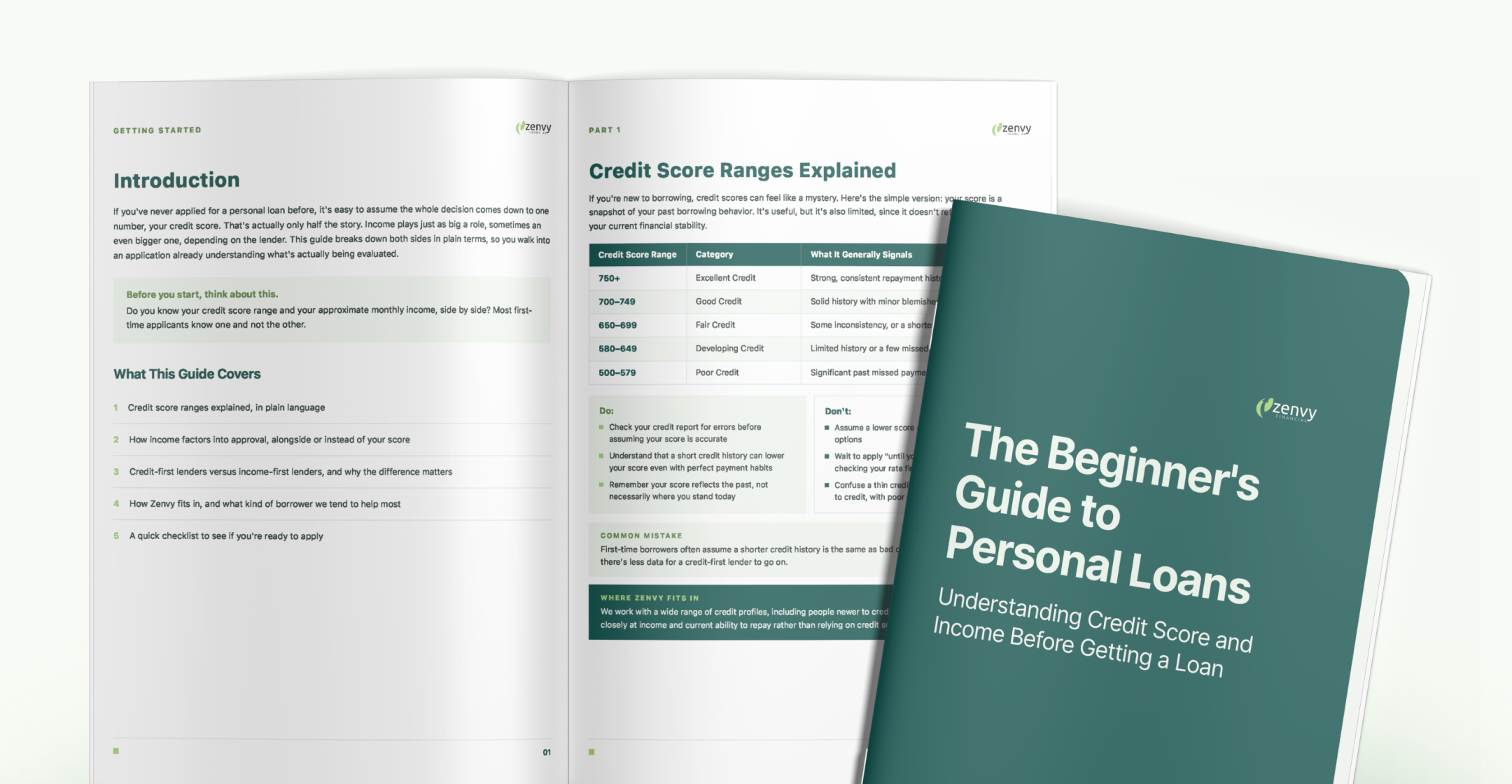
Here's a general breakdown of how credit ranges are typically categorized: 750 and above is considered excellent credit, 700 to 749 is good credit, 650 to 699 is fair credit, 580 to 649 is developing credit, and 500 to 579 is considered poor credit. Wherever you fall in that range, it's worth knowing that the category itself doesn't automatically determine your outcome with every lender, it depends heavily on whether that lender is evaluating your score alone or your full financial picture.
How Lenders Evaluate Borrowers With Lower Credit
Credit score is one input in a lending decision, not the entire decision. Along with credit history, lenders typically look at current income, existing financial obligations relative to income, employment stability, and banking history. Lenders vary significantly in how they weigh these factors. Some rely almost entirely on credit score, while Zenvy Financial builds its process around income and repayment ability first, evaluating what a borrower can currently afford to repay rather than leaning primarily on a credit score that may not reflect their present situation.
Current Income
Lenders assess whether you can realistically afford the monthly payment based on what you earn now.
Existing Financial Obligations
How much of your income is already committed relative to what you're requesting.
Employment Stability
Consistent income history can offset a lower credit score in some lenders' evaluations.
Banking History
Account activity and any recent overdrafts can factor into a lender's review.
Why Rates Are Often Higher for This Type of Loan
Lenders price loans based on the risk they're taking on, and a lower credit score is generally treated as an indicator of higher risk, regardless of a borrower's current income or financial stability. Two lenders can look at the exact same application and arrive at very different rates, depending on whether they weigh credit history or current income more heavily. This is part of why applying with a lender like Zenvy Financial, one that's transparent about evaluating income alongside credit, can mean a meaningfully different outcome than applying with a credit-first lender.
Local Banks
Usually the strictest approval standards, with credit score playing the largest role.
Credit Unions
May offer flexibility for existing members, but approval still often depends on credit history.
Other Online Lenders
Often more accessible than banks, though approval can still lean heavily on credit score.
Zenvy Financial: Built for Every Credit Range
An evaluation built around income and current ability to repay, giving borrowers with poor or developing credit a clearer path to qualifying than a credit-first lender typically would.
How Your Situation Can Change, and How Zenvy Financial Sees It Today
Checking your rate with Zenvy Financial takes a few minutes and won't affect your credit, so you can see exactly where you stand before deciding on anything.
A lower credit score today doesn't necessarily reflect your qualification odds a year from now, or even right now. Consistent income, timely payments on existing obligations, and manageable overall financial obligations can all shift how a lender views your application, even before your credit score itself moves. Zenvy Financial evaluates current income and repayment ability, giving you a more accurate read on where you actually stand today, instead of where your credit history says you stood in the past.